The Four-Payment Illusion: How Buy Now, Pay Later Quietly Breaks Your Budget in 2026
Buy now, pay later feels harmless at checkout, but the real cost shows up later. Here's how BNPL actually affects your budget in 2026, and when it's genuinely fine to use.
Listen
Your browser does not support built-in text-to-speech.
Four payments of $25 sounds nothing like $100. That's the entire trick, and it works even on people who know it's a trick.
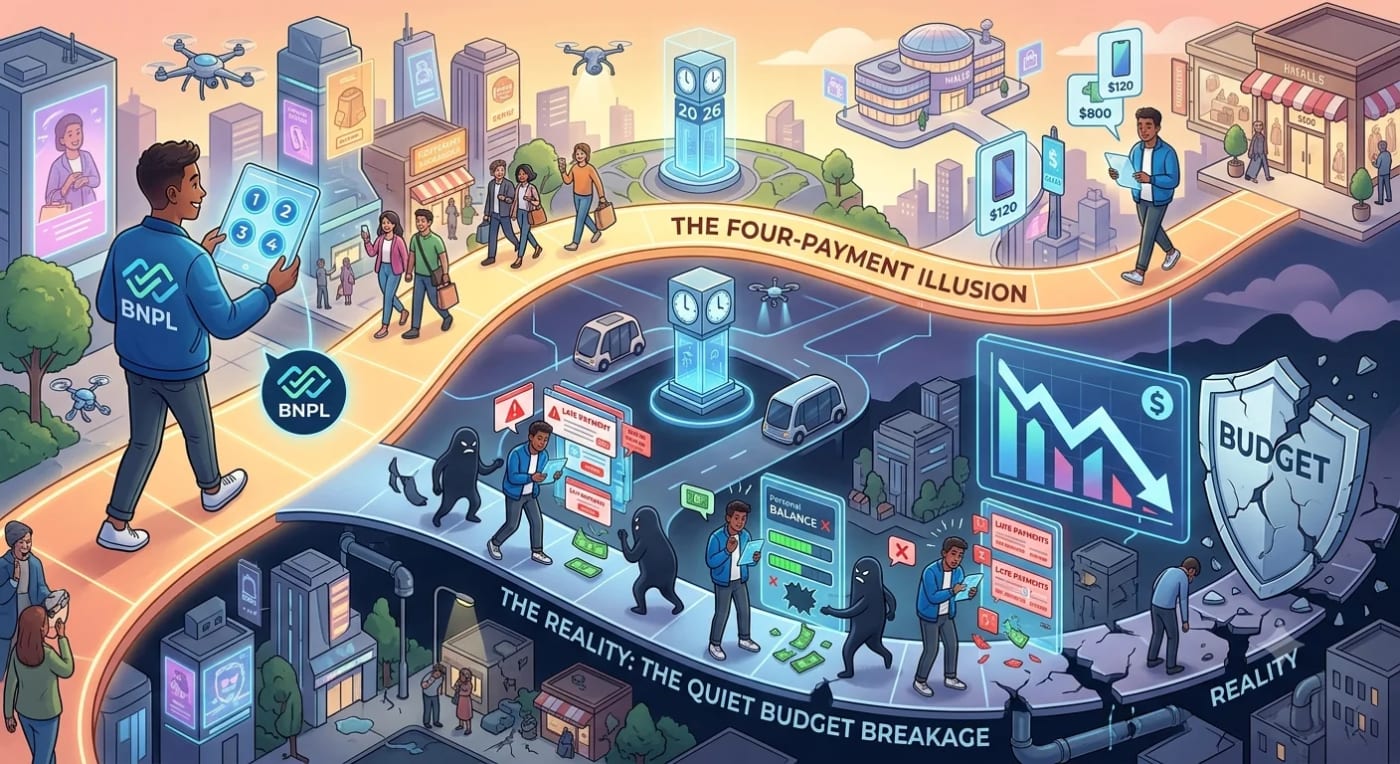
Buy now, pay later has quietly become the default checkout option almost everywhere, not just for big purchases but for things that used to just get put on a debit card without a second thought. The math on any single purchase looks fine in isolation. The problem shows up once three or four BNPL plans are running at the same time, on different schedules, pulled from an account that doesn't actually have much slack in it.
How Does Buy Now, Pay Later Actually Affect a Budget?
Buy now pay later affects a budget by splitting the psychological weight of a purchase away from its total cost, which makes people spend more than they would if paying the full price upfront. Studies on payment friction have shown this pattern for decades with credit cards; BNPL simply removes even more friction than a credit card does, since there's no interest calculation visible and often no hard credit check standing between the shopper and the "yes."
The real budget damage isn't any individual plan. It's the stacking effect. A person juggling three or four BNPL plans, each with its own biweekly withdrawal date, is essentially running an informal, unmonitored debt schedule that doesn't show up on a single statement anywhere. Miss one payment and most services report it to collections or apply a late fee that can be a large percentage of the remaining balance, not a flat token amount.
Is Buy Now, Pay Later With No Credit Check Actually Riskier?
Buy now pay later no credit check options tend to carry more risk, not less, because the absence of a credit check often means the approval process isn't weighing whether the purchase actually fits someone's existing financial picture. A hard credit check exists partly to catch overextension before it happens. Skip that step and the safety net disappears along with it.
This matters more in specific categories. Buy now pay later flights and buy now pay later furniture purchases tend to be larger dollar amounts than the typical BNPL clothing order, which means missed payments carry a heavier consequence. Buy now pay later tires falls into a strange middle category: often a genuine necessity purchase, made under time pressure, which is exactly the situation where people are least likely to shop around the terms carefully.
Why Do BNPL Catalogs Make This Worse Than a Single Purchase Would?
Buy now pay later catalogs, the kind that let a shopper browse an entire virtual storefront with installment pricing shown next to every item, change the decision-making process itself, not just the payment method. When installment pricing is the default number shown on every product, the mental math shifts from "can I afford this" to "can I afford this payment," and those aren't the same question.
That shift is subtle and it's exactly why BNPL doesn't feel like debt while it's happening. A $60 item shown as "4 payments of $15" reads as a smaller commitment than it is, even though the total obligation hasn't changed at all. Multiply that across a shopping season and the gap between perceived and actual spending can get wide fast.
Does BNPL Ever Make Sense as Part of a Real Budget?
Yes, BNPL can work reasonably well for a single, planned purchase where the total cost is already budgeted and the payment schedule is tracked deliberately, rather than treated as free money. The difference between BNPL as a useful tool and BNPL as a budget problem usually comes down to whether it's one plan being tracked closely or several running at once without a clear view of the total.
An equalized payment plan, the kind utility companies offer to spread a bill evenly across the year, works on a genuinely different principle worth contrasting here: it's smoothing a predictable, recurring cost, not financing a discretionary purchase you wouldn't otherwise make. BNPL gets marketed with similar "smoother budgeting" language, but the underlying purpose is usually different, and it's worth noticing the difference before assuming the two work the same way.
For anyone rebuilding better spending habits generally, the ideas covered in Rich Habits 2026 go into the broader mindset shift that makes this kind of tracking easier to sustain. And if BNPL payments are already stacking up in a way that's hard to see clearly, the practical steps in Cash Control 2026 walk through untangling that kind of situation.
Conclusion
Buy now, pay later isn't inherently reckless, but treating it like free installment plans instead of real debt is where budgets quietly come apart. Track every active plan in one place, resist opening a new one before the last one closes, and ask honestly whether a purchase would still make sense if it had to be paid in full today. If the answer is no, the four payments probably aren't solving the actual problem.
FAQ
Does using buy now, pay later hurt your credit score?
It depends on the provider and whether payments are reported to credit bureaus, since practices vary across BNPL companies as of early 2026. Missed or late payments are more consistently reported and can affect credit, even when on-time payments aren't reported at all.
Is buy now, pay later worse than a credit card?
Not inherently worse, but the two carry different risks. Credit cards typically charge ongoing interest but offer a single consolidated statement, while BNPL avoids interest on most plans but makes it easy to lose track of several separate payment schedules running simultaneously.
How many BNPL plans is too many to have at once?
There's no universal number, but a reasonable guideline is to only run BNPL plans that fit comfortably within a budget already tracking every other fixed expense. If a person can't immediately say how much total is owed across all active plans, that's a sign there are too many running at once.
Comments (0)
Sign in to join the conversation.
Be the first to comment.