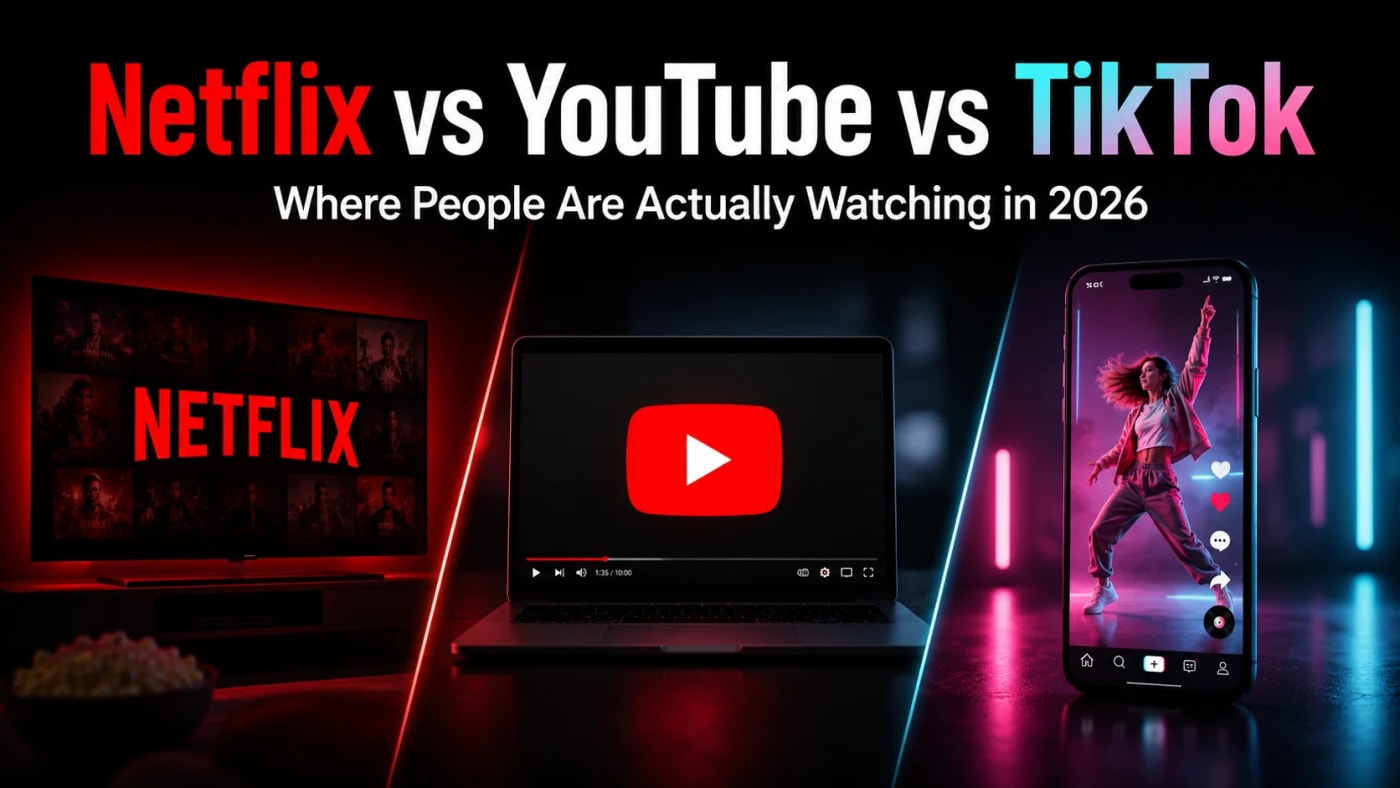
Netflix vs YouTube vs TikTok: Where People Are Actually Watching in 2026
Three platforms. Three completely different approaches to video. Three massive audiences that overlap more than any of them would like to admit.
Richard William
Jul 2, 2026
Listen
Your browser does not support built-in text-to-speech.
The early streaming conflicts that pitted Netflix against traditional television are long gone from the discussion of where people watch entertainment in 2026. Platforms that did not exist in their current form when Netflix debuted its streaming service are now the genuine competitors, functioning on attention dynamics that the original streaming model was not intended to compete with.
TikTok, YouTube, and Netflix are at odds over more than just the same hours. They are at odds over essentially distinct types of attention, moods, settings, and viewer-content connections. It is necessary to comprehend what each platform is truly selling in order to determine where audiences are genuinely heading.
Netflix in 2026: Pressure, Pivots, and the Stock Story
The market's belief in Netflix's capacity to keep viewers and increase revenue in an increasingly fragmented attention economy has been repeatedly reflected in the company's stock price. The volatility in netflix stock price during 2026 reveals a corporation negotiating actual friction between its content investments, subscriber growth objectives, and the rising expenditure of sustaining the catalogue quality that justified premium subscription pricing in the first place.
The decision to terminate popular programs has become one of the most controversial aspects of Netflix's programming strategy. Netflix's decision to cancel the popular series "The Residence" sparked strong criticism from viewers and extensive media coverage, highlighting the particular annoyance that arises when viewers devote their emotions to a program that ends before a suitable resolution.
This trend, which is well-liked enough to draw viewers yet cancelled before it's finished, has turned into a serious problem for the platform's credibility. In 2026, viewers of Netflix original content are becoming more circumspect about starting them before knowing if they would be permitted to finish. Netflix's commercial algorithmic cancellation decisions result in a cultural cost that builds up over time in viewer behaviour and emotion rather not necessarily showing up right away in membership counts.
A separate aspect of Netflix's 2026 content plan is shown by Finding Her Edge. Content in this category, particular and character driven with a distinct target, performs differently in the Netflix ecosystem than broad appeal tentpole movies. Even when headline numbers are lower than those of the platform's biggest productions, specialised content can nonetheless attract highly devoted viewers, as demonstrated by the discovery of her edge Netflix audience engagement pattern.
YouTube in 2026: The Platform That Quietly Won
While Netflix and TikTok attract more entertainment industry analysis and cultural discourse, YouTube has been accomplishing something more durable in the background. It has become the default destination for a type of viewing that no other platform serves as well: long form content chosen by interest rather than algorithm, consumed at the viewer's pace, revisited and referenced across months and years.
In their own way, YouTube outages that cause increases in search traffic are informative. When YouTube has outages, the volume of individuals checking if the platform is down demonstrates how firmly established it has become in daily media routines. Entertainment platforms that people immediately notice the absence of have achieved a different kind of penetration than those that could disappear for an hour without anyone registering it.
YouTube's audience in 2026 is not primarily there for entertainment in the traditional sense. They are there for education, for long form conversation, for documentary style content, for commentary, for the specific creators they follow who cannot be found elsewhere. This makes YouTube's audience more durable than it might appear in pure entertainment comparisons, because the switching cost is higher when the content is creator specific rather than show specific.
The youtube to mp3 converter and youtube to wav search behavior tells an interesting secondary story about how audiences relate to YouTube content. The consistent high search volume around youtube mp3 converter and youtube to wav tools reflects an audience that wants to take YouTube audio with them beyond the platform. This behavior is unique to YouTube among the three platforms being compared here and reflects the degree to which music, podcasts, and long form audio content have become central to what YouTube actually delivers for a significant portion of its audience.
TikTok in 2026: Still Growing, Still Misunderstood
The most common error entertainment industry analysts make regarding TikTok is considering it as a short video platform competing for the same attention as longer form material.
TikTok is not competing with Netflix for the two hours someone might spend watching a series on a Friday evening. It is competing for the thirty seconds between other activities, the ninety seconds while something heats up in the microwave, the accumulated fragments of attention that exist throughout a day that no other entertainment format was efficiently capturing before short form video existed.
Understanding how to use tiktok as a viewer reveals something about why the platform retains attention so effectively. The algorithm learns individual preference faster than any preceding entertainment recommendation system. The information a viewer sees is tailored to their unique interests, emotions, and behaviours in a comparatively short amount of time, which feels qualitatively different from more general platform recommendation engines.
Tiktok emojis and the specific visual language that has developed within the platform's community are markers of a distinct culture that has formed around the content itself. This cultural layer, the shared references, the reaction formats, the community specific humor and communication style, creates engagement beyond the content being viewed. Tiktok story viewer patterns suggest that audiences are not passively consuming content on TikTok in the way they consume it on other platforms. They are participating in a community organized around content.
What Netflix Cancellations Tell Us About Audience Trust
The news that netflix cancels popular series the residence and similar decisions have generated significant audience frustration is a data point worth examining carefully for what it reveals about the current entertainment relationship between streaming platforms and their subscribers.
A certain sort of viewer loyalty was created by appointment television, where viewers committed to a show for a whole season or several seasons knowing it will end. The streaming model both disrupted and strengthened this kind of viewer devotion.
The disruption: streaming viewers might leave at any moment, so services are in constant competing for renewal attention.
The deepening: An audience's genuine involvement in a show is as real as any appointment television produced, and their genuine emotional connection is reflected in their frustration when it is cancelled without a resolution.
Netflix cancels popular shows choices predicated on subscriber acquisition and retention measures rather than audience happiness criteria will continue to generate this tension. Entertainment platforms that discover methods to honour audience investment, whether through comprehensive story arcs, satisfying ends, or explicit transparency about content lifetime, are producing something that pure content volume strategies cannot simply imitate.
Finding Her Edge Netflix and the Niche Content Opportunity
In contrast to the platform's initial focus on tentpole productions with wide appeal, the identification of her edge Netflix content category—specific, character-driven, and appealing to a clearly defined audience—represents a smart strategy.
Entertainment watchers in 2026 are not looking for entertainment tailored to appeal to everyone. They are looking for material that speaks directly to them, that reflects their unique experience or interest with depth and specificity that broad audience content cannot accomplish.
Understanding this, the platforms are investing in more specialised content rather than fewer projects with a broad audience. The finding her edge netflix method, material that wins deep allegiance from its specific audience rather than broad but shallow viewership from a broader one, is gaining favour in entertainment strategy talks across the business.
Where Is the Audience Actually Going?
The honest answer to where people are actually watching in 2026 is that they are watching across all three platforms, but for genuinely different purposes that rarely compete directly with each other.
Netflix serves the dedicated entertainment session. The evening set aside for a series, the weekend afternoon movie, the deliberate choice to sit down and watch something. Netflix stock price is sensitive to whether enough of those sessions are happening to justify premium subscription pricing, and the content decisions that affect those sessions, including which shows get renewed and which get cancelled, carry real commercial consequences.
YouTube serves interest driven viewing. The creator you follow, the topic you are researching, the long form conversation you want to hear while you do something else. The is youtube down concern and the youtube to wav extraction behavior both reflect how embedded YouTube has become in daily information consumption beyond pure entertainment.
TikTok serves fragmented attention. The moments between other activities, the discovery mechanism that surfaces content a viewer would never have searched for, the community participation that makes passive viewing into something more active. How to use tiktok effectively as a viewer is increasingly something people learn from other TikTok users rather than from any external guide, which reflects how organic the platform's culture has become.
Three platforms. Three different relationships with time and attention. All three growing simultaneously in 2026, because they are not actually competing for the same thing.
Atop Trends covers entertainment news, streaming platform analysis, celebrity culture, and the business of media for readers who want to understand where entertainment is going next.
Comments (0)
Sign in to join the conversation.
Be the first to comment.