Minimalist Window Treatments for 2026: 11 Stylish Ideas for Privacy, Natural Light and a Cleaner Home
Minimalist window treatments work best when every layer has a reason to exist. These 11 ideas focus on privacy, daylight, comfort and proportion rather than decoration for its own sake.
Feroz Khan
Aug 26, 2026
Listen
Your browser does not support built-in text-to-speech.
A window treatment can fit the opening perfectly and still make the room feel off. Too much fabric can drag the wall down. A rod placed too low can make the ceiling feel shorter. A bulky blind can turn a good view into background noise.
That is why minimalist window treatments work best when they start with the room instead of the product. Recent Better Homes & Gardens coverage favors cleaner rollers, Roman shades, café curtains, and better-fitted drapery over bulky valances. Window treatments look better when they have a clear reason to be there.
At A Top Trends, the 2026 approach is simple: solve privacy, light, comfort, or proportion first. The style should come after that.
When the View Is Good, Keep the Treatment Quiet
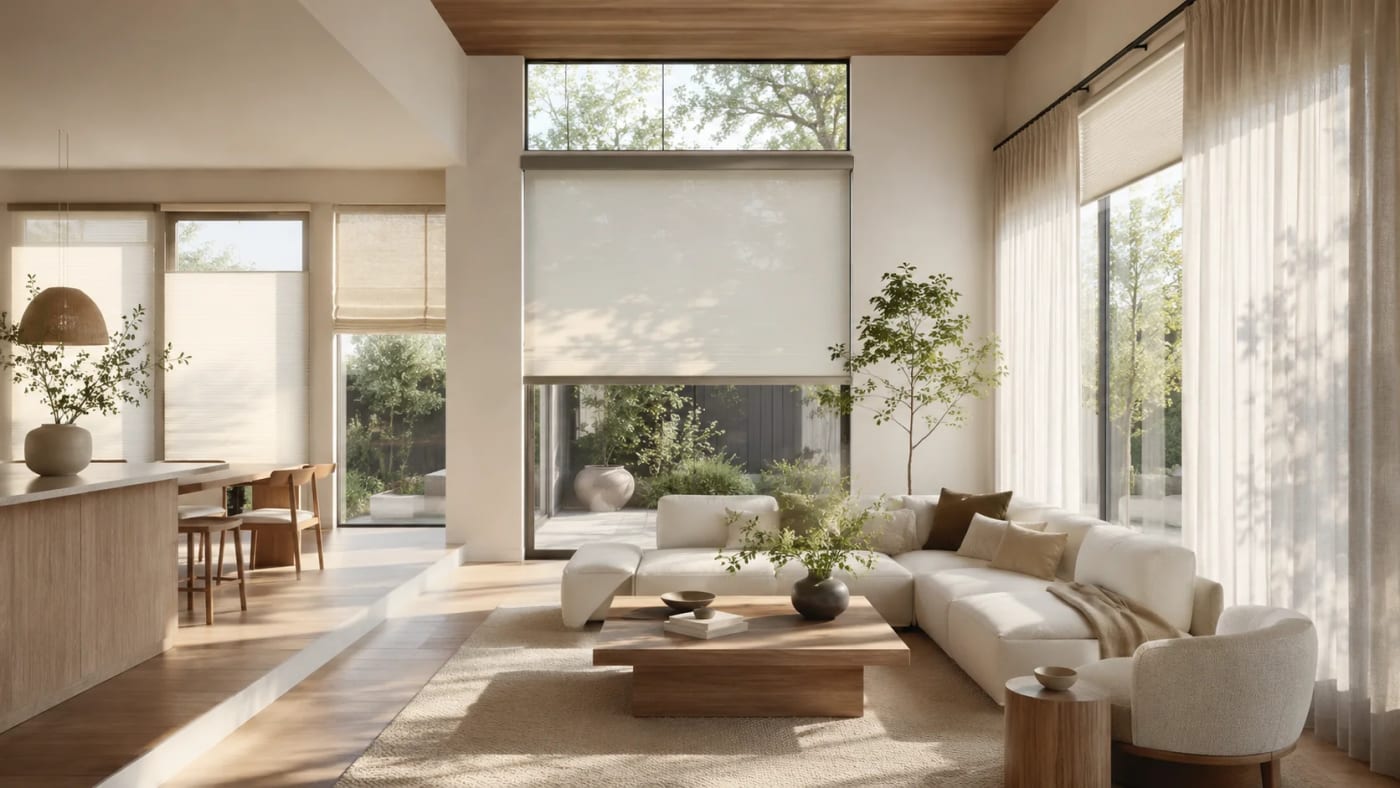
1. Utilize roller shades when the window itself merits of the focus of the window in itself. A stylish inside-mounted roller shade can cut down on the brightness and offer privacy throughout the day, without covering the frame. Once it's folded up, it can be very difficult to tell the remaining. That makes roller shades especially useful for living room window treatments where the view is already doing most of the visual work.
2. Choose Roman shades when a roller feels too stark. Roman shades add fabric without spreading it across the whole wall. Architectural Digest continues to feature them as a strong curtain alternative. For modern minimalist window treatments, flat folds, linen, and quiet woven fabrics usually feel more natural than heavily gathered versions.
3. Let cellular shades solve a comfort problem. If a bedroom overheats in direct sun or a sitting area feels cold beside the glass, decoration is not the main issue. The U.S. Department of Energy says well-fitted cellular shades can improve window energy performance In that situation, energy efficient window treatments may be more useful than another decorative layer.
Privacy Does Not Mean Covering the Whole Window
Privacy is often portrayed as if it were all or nothing even when just a portion or all of it is visible to people who walk by.
4. Café curtains work because they stop where the privacy problem stops. They cover the lower section while leaving the upper glass open to natural light. House Beautiful has heralded their revival, particularly in kitchens and breakfast areas. A simple, semi-sheer or linen curtains have a modern simple design while covering windows with minimal styles.
5. Apply sheer curtains during daylight, layering stronger fabric at night for added privacy and darkness. While sheers may soften sunlight's harsh glare, they may not offer adequate protection after sunset. Pairing them with one plain second layer adds flexibility. Architectural Digest's current window treatment ideas show how restrained layering can add depth without making the window feel overloaded.
6. Top-down shades offer adequate eye level privacy in situations where privacy is paramount at the eye level. These window treatments cover the lower part of the glass, leaving the upper section unobscured. They are ideal for bedrooms, bathrooms office spaces, home offices and rooms on the first floor with sidewalks. There are few other options that offer such little privacy or control, without being visually heavy.
Better Proportion Usually Beats More Decoration
Some windows do not need a more interesting fabric. They need to sit better within the wall.
7. Mount with the wall in mind, not only the frame. A Roman shade placed slightly above the trim can make a small window feel taller. Curtains hung closer to the ceiling can have the same effect. In compact rooms, that shift often matters more than another pattern or trim. Our A Top Trends guide to small-space ideas that look more expensive uses the same visual principle.
8. Let the treatment borrow from the wall color. Warm white against warm white, oatmeal linen against beige, or charcoal against a dark wall can make the window feel integrated rather than separately decorated. The colors only need to feel as though they belong in the same room.
9. If you layer, let one material carry the personality. A natural Roman shade with soft ivory drapes can create depth without loud contrast. This works particularly well for minimalist window treatments for living room spaces where daytime light and evening privacy need different answers. One layer can bring texture. The other can simply stay quiet.
Small Details Decide Whether the Window Feels Calm
10. Choose cordless blinds or shades where possible. The cleaner appearance is useful, but safety is the stronger reason. It is the U.S. Consumer Product Safety Commission suggests that the safest choice for children who are in the home is to make use of cordless window curtains If you're replacing old window shades, this is an appropriate upgrade.
11. Leave a good window mostly alone. If privacy is being managed and the sun's rays are manageable and the view is worthy of focus, a single roller shade or one sheer could be sufficient. There's no reason to add layers just because a blank window isn't finished.
Natural light also changes how a room feels in the morning. If you are trying to make the rest of the home feel calmer too, A Top Trends also covers building a more offline daily life and healthy morning habits.
Let the Window Tell You What It Needs
The best minimalist window treatments are not necessarily the plainest. Roman shades can have texture. Café curtains can feel warm. Floor-length linen panels can still look restrained. What matters is whether the treatment fits the room and solves something real.
Before buying anything, look at the window at different times of day. Morning may reveal glare. Late afternoon may reveal heat. Evening may show that privacy is the only issue. If the current treatment makes the wall feel shorter or heavier, the problem may be proportion rather than style.
That is the difference between a window that looks decorated and one that feels resolved.
Frequently Asked Questions
What is the most minimalist windows for your living space?
There's no perfect solution. Shades made of rollers are ideal for rooms with a an expansive view. Roman shades offer a soft, controlled look and floor-length curtains are ideal in the evening when privacy is important. Select the shades that best suit your space's need for privacy and light.
Are Roman shades suitable for minimalist spaces?
Yes. Flat Roman shade provides the window with softness and texture without spreading the fabric all over the wall. Simple folds and neutral colors are ideal when the space is quiet visually.
What window treatments offer privacy while not blocking natural light?
Café curtains, top down cell shades blinds, sheers, and shade shades that filter light can all perform. If privacy is required only at the eye level, then there's probably no reason to cover the glass above.
Are cordless blinds worth choosing?
Yes, especially where young children live or visit. Cordless blinds and shades remove hanging controls from the frame and create a cleaner appearance, while CPSC guidance identifies cordless window coverings as the safest option around children.
Comments (0)
Sign in to join the conversation.
Be the first to comment.